How to Rank in the US: A Link Building Roadmap
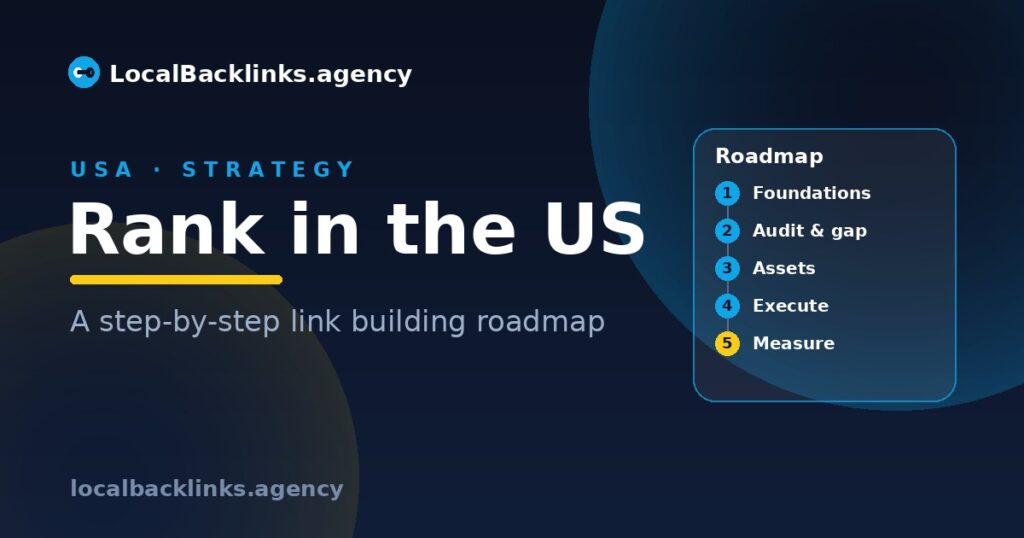
Most US link-building campaigns fail for the same reason: they start building links before there’s a plan, a target, or a page worth linking to. In the most competitive market in search, random links don’t rank you — a sequence does. This is the roadmap we’d follow to rank a site in the US, phase by phase, in the order that actually works. For the full background, see our complete guide to US backlinks; this article is the practical playbook.
Phase 0: Fix the foundations first
Before a single link, make sure links are even your bottleneck. In the US, you’re competing against sites with strong everything, so pouring authority into a weak page wastes money. Confirm these are in place:
- Content that matches intent. Does your target page genuinely answer the query better than the current top results? If not, fix that first — links amplify good pages, they don’t rescue thin ones.
- On-page basics. Title, structure, internal links and search-intent match all sorted.
- Technical health. Fast, mobile-friendly, crawlable, indexed.
- E-E-A-T signals. A real business, named authors, credible information — especially in YMYL niches.
If these are weak, spend your first effort here. It’s the least glamorous phase and the one that determines whether everything after it works.
Phase 1: Audit where you stand
You can’t set a target without a baseline. In this phase:
- Map your current links. Check your referring domains (unique linking sites) in Ahrefs or Semrush — quantity and quality.
- Run a competitor-gap analysis. Search your target keyword, list the top 5–10 US pages ranking, and compare their relevant referring domains to yours. That gap is your real target (we detail this in how many backlinks to rank in the US).
- Note the type of links winners have. Are they ranking on digital PR, niche guest posts, local citations? That tells you which methods the niche rewards.
You finish this phase knowing roughly how many quality links you need and what kind.
Phase 2: Define your targets
Decide what you’re actually trying to rank and where:
- Priority pages and keywords. Pick the handful of pages that matter most commercially and the keywords each should rank for — one clear intent per page.
- National or local. This is the big US fork. National terms need authoritative, broad-reach links; local terms need regional and citation links. Most sites are mostly one or the other — decide which (see national vs local US link building).
- Anchor plan. Set a profile-wide, branded-led anchor mix now so you don’t over-optimise as you go (anchor text strategy).
Phase 3: Build linkable assets
This is the phase most people skip, and it’s why their outreach fails. People link to resources, not sales pages. Before heavy outreach, create at least one or two assets worth citing:
- Original data or a survey of your US market
- A genuinely useful guide, tool or calculator
- Expert commentary or research relevant to your niche
These give journalists and editors a reason to link, make digital PR possible, and earn links far more efficiently than pitching a product page. The authority then flows through your internal links to the pages you actually want to rank.
Phase 4: Execute — the right mix, the right pace
Now you build, combining methods rather than relying on one:
- Digital PR for your linkable assets — the highest-trust US links (digital PR in the US).
- Guest posts on relevant, real-traffic US sites in your niche.
- Niche edits for targeted boosts on already-ranking pages.
- Local citations and regional links if you’re competing locally.
Two rules govern this phase. First, relevance over authority — a relevant link from a modest site beats an irrelevant high-DR one. Second, pace it — build steadily over months; a sudden spike to a young site looks engineered and invites scrutiny in Google’s most-watched market.
Phase 5: Measure and iterate
Track outcomes, not link counts:
- Rankings for your target US keywords (rank tracker set to a US location).
- Referring domains growing in quality and relevance.
- US impressions and clicks in Search Console, filtered to the United States.
- Conversions — the real goal.
When you see pages climbing into positions 8–20, that’s the signal to double down on those topics. When something stalls, the bottleneck is usually content or relevance, not link count — go back to Phase 0 for that page.
A realistic US timeline
Set expectations honestly — US results compound over months, not weeks:
- Month 1: foundations, audit, target-setting, first linkable asset.
- Months 2–3: steady link building begins; early indexing and first impressions appear.
- Months 4–6: rankings start moving on lower-competition terms; refine based on data.
- Months 6–12+: competitive head terms improve as authority compounds.
Anyone promising page-one US rankings in a few weeks is selling something. The sites that win build consistently and patiently.
What derails US campaigns
- Building links to a weak page — fix Phase 0 first.
- No linkable asset — outreach falls flat without something worth linking to.
- Chasing volume and DR over relevance.
- Over-optimised anchors in a scrutinised market (avoiding US penalties).
- Impatience — quitting before the compounding kicks in.
FAQ
How long does it take to rank in the US with link building?
Usually several months — lower-competition terms in 4–6 months, competitive head terms over 6–12+. Results compound; there’s no instant route in a market this competitive.
What’s the first thing I should do?
Fix foundations and run a competitor-gap analysis before building anything. Confirm links are your actual bottleneck, then set a target from the competition.
Do I need a linkable asset to rank in the US?
It’s not strictly required, but it dramatically improves results — people and journalists link to resources, not sales pages, so an asset makes earning quality US links far easier.
Bottom line
Ranking in the US is a sequence, not a pile of links: fix the page, audit the gap, set clear targets, build something worth linking to, execute a relevant mix at a steady pace, and measure what moves. Follow the phases in order and you’ll compete efficiently in the toughest market in search. Want this roadmap run for you? See our USA backlink packages or request a free US plan with a competitor-gap analysis included.
Related reading: For the principles that apply in every market, see the complete guide to backlinks, and for the general version of this topic read how to get backlinks. To turn targets into a month-by-month plan, try the SEO campaign planner.


Leave a Reply