Avoiding Google Penalties in the US Market
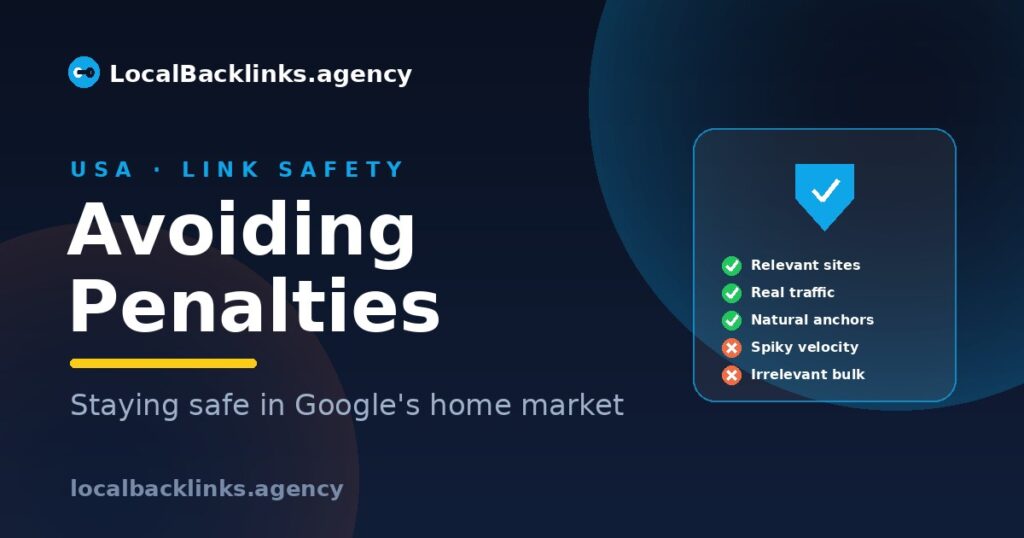
The United States is Google’s home market and the most heavily policed place in search. The upside of aggressive enforcement is that quality wins; the downside is that careless link building gets punished faster here than anywhere. This article explains how Google penalties actually work, what triggers them, the warning signs to watch for, and how to build links — and recover if needed — without putting your rankings at risk. It’s the safety backbone of everything in our complete guide to US backlinks.
The two kinds of “penalty”
People say “penalty” loosely, but there are two very different things:
- Algorithmic suppression. Google’s automated systems — including the AI-driven spam detection that succeeded the old Penguin algorithm — devalue or discount manipulative links automatically. There’s no notification; your links simply stop counting, or rankings quietly slip. This is by far the most common outcome today.
- Manual actions. A human reviewer at Google’s webspam team flags your site, typically for “unnatural links.” You’ll see a notice in Google Search Console, and affected rankings can drop sharply until you fix the issue and pass a reconsideration request.
Most sites that “get penalised” by aggressive link building actually experience the first kind — wasted budget on links that don’t count — rather than a dramatic manual action. Both are worth avoiding, and the same habits prevent both.
What triggers link penalties in the US
The patterns Google’s systems are tuned to catch are consistent:
- Irrelevant links at scale — lots of links from sites unrelated to your niche.
- Over-optimized anchors — exact-match keywords dominating your profile (see US anchor text strategy).
- Link networks and footprints — PBNs, or many links sharing the same hosting, templates or owners.
- Sudden, unnatural velocity — a spike of links in a short window, especially to a young site.
- Low-quality, trafficless sites — links from sites with inflated metrics and no real audience.
- Obvious paid-link footprints — sites that clearly sell links to anyone, with sponsored content not marked as such.
Notice the throughline: every trigger is a sign the links were placed rather than earned. Avoid looking engineered and you avoid most risk.
Warning signs to watch for
- A manual action notice in Search Console (Security & Manual Actions) — the unambiguous one.
- A ranking drop that coincides with a link campaign or a known spam update.
- Links that never get indexed or quietly disappear.
- A spike in low-quality referring domains you didn’t intend (sometimes from negative SEO or spammy vendors).
- An anchor profile dominated by exact-match when you audit it.
Catching these early — especially in your own Search Console data — lets you correct course before a small problem becomes a big one.
How to build safely in the US
The safe approach isn’t complicated; it’s disciplined:
- Relevance first. Links from sites genuinely related to your niche, every time.
- Real sites with real US traffic — not inflated, trafficless domains (see what makes a high-authority US backlink).
- Genuine content — native-quality articles, not thin or AI-spun filler.
- Natural, varied anchors — branded-led, exact-match rare.
- Steady velocity — consistent building over months, no spikes.
- Diversity — a mix of link types and sources, as a real profile has.
- A foundation of earned links — digital PR and genuine editorial links anchor a healthy profile (see digital PR in the US).
Do these and your profile looks like a real, growing business’s — which is exactly what Google wants to reward.
If you get hit: how to recover
Recovery depends on which kind of problem you have.
From algorithmic suppression
There’s no notice and no reconsideration request — you recover by improving the profile. Identify and stop the bad links, dilute over-optimized anchors with natural ones, and build genuine, relevant links over time. Recovery is gradual, tied to recrawls and updates rather than a switch flipping.
From a manual action
- Read the notice in Search Console to understand the scope (site-wide or partial).
- Audit your backlinks and identify the unnatural ones.
- Remove what you can (request removal), then disavow the rest that you genuinely can’t remove.
- Submit a reconsideration request documenting what you found and fixed.
- Wait — review takes time, and honesty about what happened helps.
A word on the disavow tool
Disavow is a last resort, not routine maintenance. Google’s systems already ignore most spammy links, so disavowing normal links you simply over-built can do more harm than good. Reserve it for genuinely toxic links you can’t remove — for example, after a manual action or a clear negative-SEO attack — and use it carefully.
The honest bigger picture
It’s worth being straight: paid link building of any kind operates within Google’s guidelines on link schemes, and no tactic is risk-free in a market enforced this strictly. The goal isn’t to find a loophole — it’s to keep risk genuinely low by making every link as relevant, real and natural as possible, and by building the site’s own legitimate authority alongside it. The closer your link profile is to what you’d earn organically, the safer and more durable your rankings are. Shortcuts that look engineered are exactly what the US market punishes.
FAQ
What’s the difference between an algorithmic penalty and a manual action?
Algorithmic suppression is automated — links are devalued with no notice. A manual action is issued by a human reviewer, shows in Search Console, and requires a reconsideration request to lift.
What most commonly triggers a links penalty?
Irrelevant links at scale, over-optimized exact-match anchors, link-network footprints, unnatural velocity spikes, and trafficless low-quality sites.
Should I use the disavow tool?
Only as a last resort for genuinely toxic links you can’t remove. Google ignores most spam automatically, so routine disavowing can backfire.
How do I know if I’ve been penalised?
Check Search Console for a manual-action notice, and watch for ranking drops that line up with a campaign or a spam update, or links that never index.
Bottom line
Avoiding US penalties comes down to one thing: build links that look earned, not placed. Stay relevant, use real sites with real traffic, keep anchors natural, pace yourself, and anchor your profile with genuine editorial links. Watch Search Console, fix problems early, and reserve disavow for true toxicity. Do that and you build durable rankings in the toughest, most-watched market in search. Want a US campaign built safety-first on relevant, real sites with transparent reporting? See our USA backlink packages or request a free US plan.

Leave a Reply