Anchor Text Strategy for Competitive US Keywords
In competitive US niches, anchor text is the single easiest way to get a link profile flagged as manipulative. The exact words your links are wrapped in are a strong relevance signal — which means an unnatural pattern is a strong manipulation signal, and Google watches it most closely exactly where competition is fiercest. This article covers what a natural US anchor profile looks like, how to vary anchors by which page they point to, and how to audit and fix a profile that’s drifted into the danger zone. For the wider strategy, see our complete guide to US backlinks.
The anchor types, briefly
- Branded — your brand or domain name. The dominant type in natural profiles.
- Naked URL — your raw web address.
- Generic — non-keyword phrases (“click here,” “this guide,” “learn more”).
- Partial-match / topical — natural phrases containing part of your keyword.
- Exact-match — your precise target keyword. The most powerful and the most dangerous.
The golden rule: mimic earned links
Everything about anchor strategy comes down to one principle: your profile should look like links you earned, not links you placed. When a US journalist or blogger links to you naturally, they overwhelmingly use your brand name, your URL, or a generic phrase — almost never your exact money keyword. So a profile dominated by branded and generic anchors looks earned; a profile dominated by exact-match keywords looks bought. The whole game is staying on the right side of that line.
Anchor distribution for competitive US niches
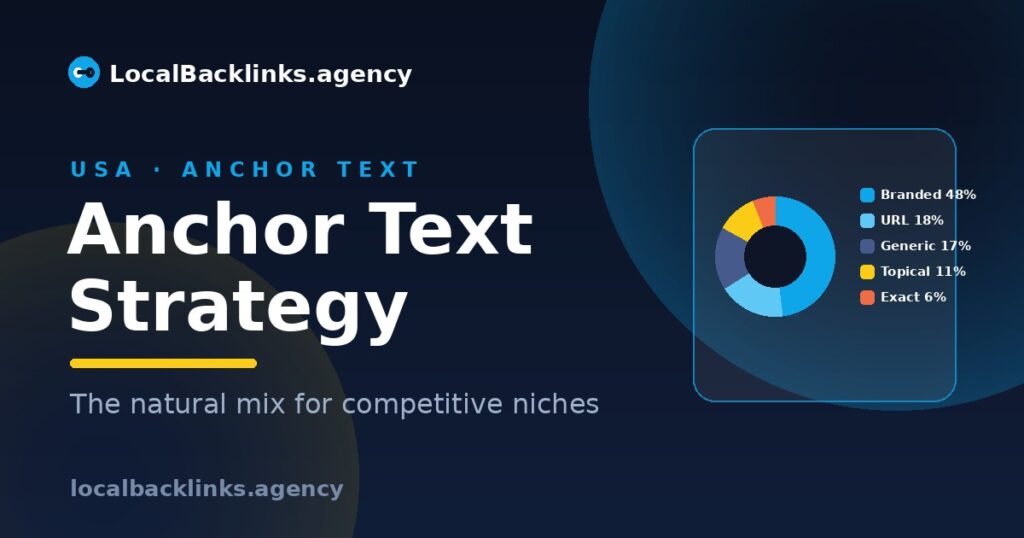
Ratios should look organic, not engineered to a formula, but a safe-leaning profile in a competitive US niche skews even more conservative than usual:
- Branded: ~45–55%
- Naked URL: ~15–20%
- Generic: ~15–20%
- Partial-match / topical: ~10%
- Exact-match: ~3–5% or less
The rule of thumb: the more competitive the keyword, the lower your exact-match percentage should be — because that’s where Google scrutinises hardest and where competitors’ natural profiles set a conservative benchmark. If exact-match is anywhere near your largest category, you’re over-optimised.
Vary anchors by the page you’re pointing to
This is the nuance most guides miss: anchor strategy should differ by target.
- Homepage: almost entirely branded and URL anchors. Natural homepage links are overwhelmingly brand mentions.
- Commercial / money pages: branded and generic-led, with topical anchors used sparingly and exact-match kept very rare. These pages attract the most scrutiny, so keep them the cleanest.
- Linkable assets, guides and blog posts: this is where topical and partial-match anchors fit naturally, because people genuinely describe the content when they link to it. Most of your descriptive anchors should land here, not on the money page.
This mirrors reality: in a natural profile, the money page gets brand links while the useful content gets descriptive ones. Building that way looks earned and keeps your commercial pages safe.
How to audit your anchor profile
Before adjusting, measure where you stand:
- Export your backlinks from Ahrefs or Semrush and group anchors into the categories above.
- Calculate the percentages for the whole profile and, separately, per target page.
- Flag the red zones: exact-match above ~5%, any single exact-match phrase repeated many times, or money pages heavy with keyword anchors.
- Compare to competitors ranking for your terms — their profiles show what “natural” looks like in your niche.
The audit tells you whether you need to keep building as-is or actively dilute.
How to fix an over-optimized profile
If your audit shows too much exact-match (common after aggressive early link buying), don’t panic and don’t remove everything — rebalance:
- Dilute, don’t delete. Build new branded, URL and generic links so the exact-match percentage falls, even though the count stays.
- Stop adding exact-match until the ratio is healthy again.
- Vary repeated anchors — if one phrase dominates, add diverse alternatives.
- Disavow only as a last resort — for genuinely toxic links, not for normal anchors you simply over-used. Over-disavowing does more harm than good.
Dilution is the safe fix: you reshape the profile by adding natural links, not by yanking existing ones.
Velocity and sequencing
Order matters as much as ratio. Early in a campaign — especially for a newer page — front-load branded, URL and generic anchors; it looks like natural discovery. Introduce topical anchors gradually, and add the rare exact-match only once a healthy base exists. A new page that suddenly attracts exact-match keyword links looks engineered immediately.
Common anchor mistakes in competitive niches
- Exact-match as the largest category — the clearest manipulation signal.
- The same keyword anchor repeated across many links.
- Keyword anchors piled on the money page instead of on content.
- No branded or generic anchors — doesn’t look earned.
- Aggressive exact-match early on a new page.
FAQ
What percentage of anchors should be exact-match in a competitive US niche?
Keep it very low — around 3–5% or less. The more competitive the term, the more conservative your exact-match share should be.
Should money pages get keyword anchors?
Rarely. Keep money pages branded- and generic-led; put your descriptive, topical anchors on guides and assets, which is where they naturally occur.
How do I fix a profile with too much exact-match?
Dilute it — build new branded, URL and generic links to lower the exact-match percentage, and stop adding exact-match until the ratio recovers. Don’t mass-remove links.
Do branded anchors actually help if they’re not keywords?
Yes — they build a natural profile and brand signals, and they make your occasional keyword anchors look earned rather than manipulative.
Bottom line
In competitive US niches, win with restraint: a branded- and generic-led profile, descriptive anchors concentrated on your content rather than your money pages, exact-match kept rare, and a natural build order. Audit regularly, dilute if you’ve over-optimised, and let your profile look like links you earned. Want anchor strategy handled as part of a US campaign on relevant, real sites? See our USA backlink packages or request a free US plan.

This post makes a strong case for monitoring anchor text diversity. I’ve seen firsthand how over-optimization can backfire, so the advice to audit regularly is really practical.