How Many Backlinks to Rank in the US?
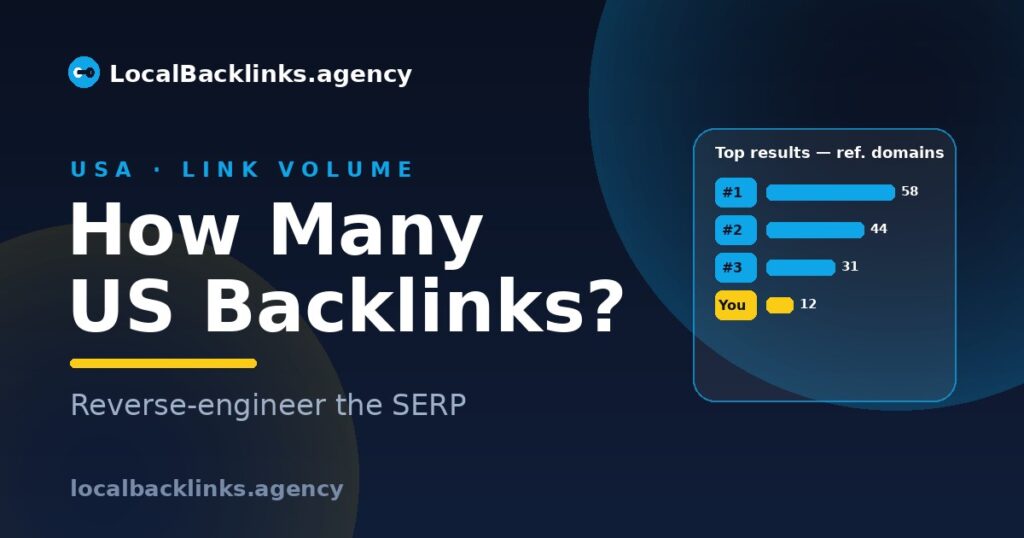
“How many backlinks do I need to rank in the US?” is the wrong question — and asking it the right way is what separates campaigns that work from campaigns that burn budget. There’s no fixed number, because the answer depends entirely on the keyword you’re chasing and who you’re chasing it against. But there is a reliable way to find your number, plus some realities about US competition that change the math. This article shows you how. For the broader strategy, see our complete guide to US backlinks.
Stop asking for a number — ask the SERP
Anyone who answers “you need 50 backlinks” without seeing your keyword is guessing. The number of links required to rank for a low-competition US term might be a handful; for a commercial head term it can be many dozens of quality referring domains. The competition sets the bar, so the only honest way to answer is to reverse-engineer the search results for your specific target. Your “how many” is whatever it takes to credibly compete with the pages already ranking — no more, no less.
Referring domains, not total backlinks
First, measure the right thing. Total backlinks counts every individual link, including dozens from the same site — easily inflated and largely meaningless. Referring domains counts the number of unique sites linking to a page, which is what actually reflects authority. Twenty links from one site is one referring domain; that’s the number that matters. Throughout this article, “links” means relevant referring domains.
How to reverse-engineer the US SERP
- Search your target keyword on Google with a US location set (or use a tool with US results).
- Take the top 5–10 ranking pages.
- Pull each page’s referring domains in Ahrefs or Semrush — at the page level, not just the whole domain.
- Judge the quality and relevance of those links, not just the count: how many are genuinely relevant US sites with real traffic?
- Compare to your page. The difference between your relevant referring domains and theirs is your target.
If the top US results have 30–60 relevant referring domains each and you have 8, you now have a grounded goal — and a sense of whether it’s a months-long push or a quick win.
US competition tiers (rough ranges)
Use these only as orientation, then confirm with real SERP data — actual numbers vary enormously by niche:
- Low competition (long-tail, local, niche terms): often a modest set of relevant links — sometimes single digits — is enough. Relevance matters more than volume here.
- Medium competition (mid-tier commercial terms): a steady programme of relevant links over several months, matching competitor referring-domain counts.
- High competition (commercial head terms, competitive niches like SaaS or finance): often dozens of high-quality referring domains, built over quarters, alongside strong content and authority.
The US generally sits higher on these ranges than smaller markets, because the competition simply has more — and better — links.
Quality compresses the number
Here’s the lever most people miss: the competitor-gap count assumes similar link quality. If your links are more relevant and authoritative than your competitors’, you can often rank with fewer of them. Ten genuinely relevant, real-traffic US links can outperform fifty weak ones. So treat the gap number as a ceiling, not a quota — strong links let you hit the target with fewer placements (see what makes a high-authority US backlink).
When you need FEWER links than competitors
Links aren’t the only ranking factor, so a stronger site can rank with fewer of them. You may need fewer links than the competition if your page has:
- Better content that matches intent more completely than the current results.
- Stronger topical authority — an established, focused site in the niche.
- Better technical health and user signals.
- More relevant links, even if fewer in number.
Conversely, if your content or site authority is weak, you’ll need more links to compensate — and it’s often cheaper to fix the page than to out-link the competition. Always check whether links are really your bottleneck first.
Diminishing returns and the plateau
More links don’t help forever. Once you’ve closed the gap with the SERP and matched the competition’s quality and quantity, additional links deliver less and less — you hit a plateau where content, intent and site authority decide the final positions. Pouring more links into a page that has already caught the field is wasted budget. Recognise the plateau, and shift effort to content or to other pages rather than over-building one URL.
Velocity: how fast in the US
How fast matters as much as how many. A sudden spike of links to a young site looks unnatural, and the US is the most-watched market. Build steadily — a consistent pace over months reads as genuine growth. Newer sites should start slow; established sites can absorb more, but consistency beats bursts every time.
How to track it
- Referring domains over time (quality and relevance, not just count).
- Rankings for your target US keywords, tracked from a US location.
- US impressions and clicks in Search Console.
If rankings climb as your relevant referring domains approach the competitor benchmark, you’re on track. If they don’t, the bottleneck is usually content, relevance or site health — not link count.
Common mistakes
- Quoting a fixed number instead of reverse-engineering the SERP.
- Counting total backlinks rather than unique relevant referring domains.
- Over-building past the plateau on a page that’s already competitive.
- Buying fast and cheap to “catch up” — velocity spikes and weak links backfire.
- Treating links as the only factor when content or authority is the real gap.
FAQ
How many backlinks do I need to rank #1 in the US?
It depends entirely on the keyword. Reverse-engineer the top-ranking pages’ relevant referring domains and aim to match them with quality links. There’s no universal figure.
Is it total backlinks or referring domains that matter?
Referring domains — the number of unique sites linking to you. Total backlink counts are easily inflated and far less meaningful.
Can I rank with fewer links than competitors?
Yes, if your content, relevance, topical authority and links are higher quality. Quality compresses the number you need.
Does building more links always help?
No. Past the point where you’ve matched the competition, returns diminish and content and authority decide the rest. Over-building one page wastes budget.
Bottom line
There’s no magic number of US backlinks — there’s your number, set by the pages already ranking for your keyword. Measure their relevant referring domains, match the gap with quality links, recognise when you need fewer (or when links aren’t the bottleneck at all), and stop at the plateau. Build steadily, and let SERP data — not a quota — guide you. Want a competitor-gap analysis and a realistic link target for your US keywords? Request a free US plan, or see our USA backlink packages.
Related reading: For the principles that apply in every market, see the complete guide to backlinks, and for the general version of this topic read how many backlinks you need and referring domains vs backlinks. For a rough starting range, use the required backlinks estimator.


This really clarifies why focusing on a specific backlink number is misleading. Different keywords clearly need different approaches, and emphasizing quality over quantity makes a lot more sense when planning a strategy.
The point about reverse-engineering the actual US SERP instead of chasing a fixed backlink number really resonated with me. In visual-tool niches like AI image enlargement, competitor authority can vary widely, so identifying the ranking pages’ link quality and topical relevance seems much more useful than treating every backlink as equal.
The point about reverse-engineering the actual US SERP instead of chasing a universal backlink number is especially useful. I also liked the discussion of diminishing returns—once a page has enough relevant authority, improving search intent coverage or content quality may matter more than simply building more links.
The point about reverse-engineering the actual US SERP instead of chasing a universal backlink number is especially useful. I also liked the discussion of diminishing returns—once a page has enough relevant, competitive links, improving content and matching search intent may matter more than continually building more links.
The point about reverse-engineering the actual US SERP instead of chasing a fixed backlink number is especially useful. I also liked the discussion of diminishing returns—once a page has enough relevant, authoritative links, improving topical coverage and content quality may matter more than simply adding more.