Niche Edits vs Guest Posts: Which Is Better?
Two of the most common ways to build links are guest posts and niche edits — and people constantly ask which is better. The honest answer: neither is universally better; they do different jobs, and most strong US campaigns use both. This article explains exactly how each works, their pros and cons, what they cost in time and money, and how to decide which to use when. For the wider strategy, see our complete guide to US backlinks.
What’s the difference?
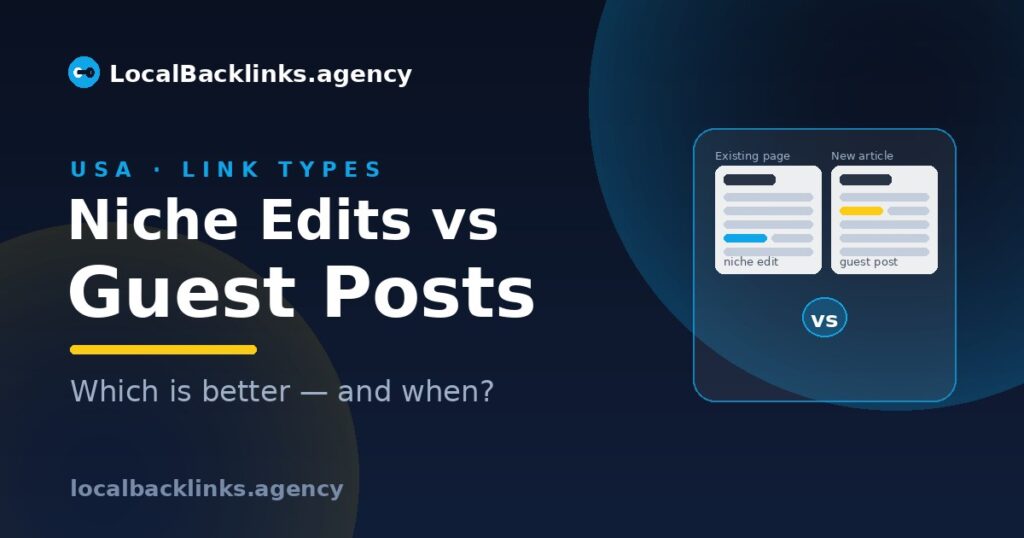
A guest post is brand-new content you contribute to another site, with a link back to yours. The article is created specifically, usually around a topic that lets your link fit naturally.
A niche edit (also called a link insertion or curated link) adds your link into an existing, already-published article on another site. No new content is created — your link is woven into content that’s often already indexed and may already have authority and traffic.
In short: a guest post creates the page your link lives on; a niche edit places your link into a page that already exists.
Guest posts: pros and cons
Pros:
- You control the content and context — the article can be built around your link and keywords.
- Full, relevant articles can read more naturally and provide more context for the link.
- Often easier to secure on quality sites that accept contributions but don’t sell edits.
- Adds fresh content and exposure, not just a link.
Cons:
- The new page starts with zero authority and traffic — it has to earn its own over time.
- More work: pitching, writing and editing to the host’s standards.
- If placed on a weak or farm site, the fresh page may never get indexed or read.
(For the full playbook, see guest posting in the USA.)
Niche edits: pros and cons
Pros:
- The host page may already be indexed, aged, and carry authority and traffic — so the link can pass value faster.
- Usually quicker to place than writing and pitching a full article.
- Efficient for boosting pages that are hard to earn fresh links to (like e-commerce categories).
Cons:
- Relevance is make-or-break — the link must genuinely fit the existing content, or it looks (and is) inserted.
- Less control: you’re adding to someone else’s article, not building context around your link.
- Higher abuse potential — some sellers insert links into thin or irrelevant old posts, which adds little.
- Can look manipulative if the edit is obviously bolted on.
Speed, cost and effort
- Speed: niche edits are usually faster to place; guest posts take longer (writing + pitching + editorial review).
- Time-to-value: a niche edit on an aged, indexed page may pass value sooner; a guest post’s new page builds value over time.
- Cost: varies by site quality more than by type — a great site costs more either way; don’t let a low price tempt you onto a weak site.
- Effort: guest posts require more content work; niche edits require more careful relevance vetting.
Which should you use?
Match the method to the goal:
- Lean guest post when you want control over context, want to target a topic precisely, or the best relevant sites only accept contributions.
- Lean niche edit when you want a faster placement, want to tap an existing page’s authority, or you’re boosting a page that’s hard to earn fresh editorial links to.
- Use both for a natural profile — real sites earn a mix of new mentions and links added to existing content over time, so a blend looks more organic than relying on one.
The factor that matters more than the type
Whichever you choose, the site and the link quality decide the outcome — not the label. A relevant, real-traffic US site with a genuine, in-content link passes value whether it’s a guest post or a niche edit. A weak, irrelevant site passes little either way. So apply the same standard to both: relevance, real traffic, editorial context, clean profile and indexation (see what makes a high-authority US backlink). And keep anchors natural in both formats (see US anchor text strategy).
Safety notes for both
Both are paid-link methods in most commercial cases, so the same risk principles apply: relevance, genuine content, natural anchors and a sensible pace keep them defensible; irrelevant, bulk, exact-match placements invite trouble in Google’s most-scrutinised market. A niche edit shoved into an unrelated old post, or a guest post on a farm, is the high-risk version of each — avoid those regardless of price.
Common mistakes
- Choosing by type instead of by site quality — the site matters more than the label.
- Niche edits into irrelevant or thin pages — relevance is everything for edits.
- Guest posts on farms — fresh content on a weak site rarely gets read or indexed.
- Going 100% one type — a natural profile blends both.
- Chasing the cheapest option — low price usually means low quality in either format.
FAQ
Are niche edits better than guest posts?
Neither is universally better. Niche edits can pass value faster via aged pages; guest posts give you more control and context. The site’s quality matters more than the type.
Are niche edits safe?
They can be, when the link is genuinely relevant to the existing content on a quality site. They’re risky when inserted into irrelevant or thin pages purely for SEO.
Which is cheaper?
Cost tracks site quality more than format. A strong site costs more either way; a suspiciously cheap link of either type usually signals a weak site.
Should I use both?
Yes — a blend of guest posts and niche edits looks more natural than relying on one, and lets you match method to goal.
Bottom line
Guest posts create the page your link lives on; niche edits place your link into an existing one. Guest posts give control; niche edits can pass value faster. But the real decision isn’t the type — it’s the quality and relevance of the site. Use both, hold each to the same standard, keep anchors natural, and build at a steady pace. Want a campaign that uses the right mix on genuinely relevant US sites? See our USA backlink packages or request a free US plan.

Leave a Reply