National vs Local US Link Building: Which You Need
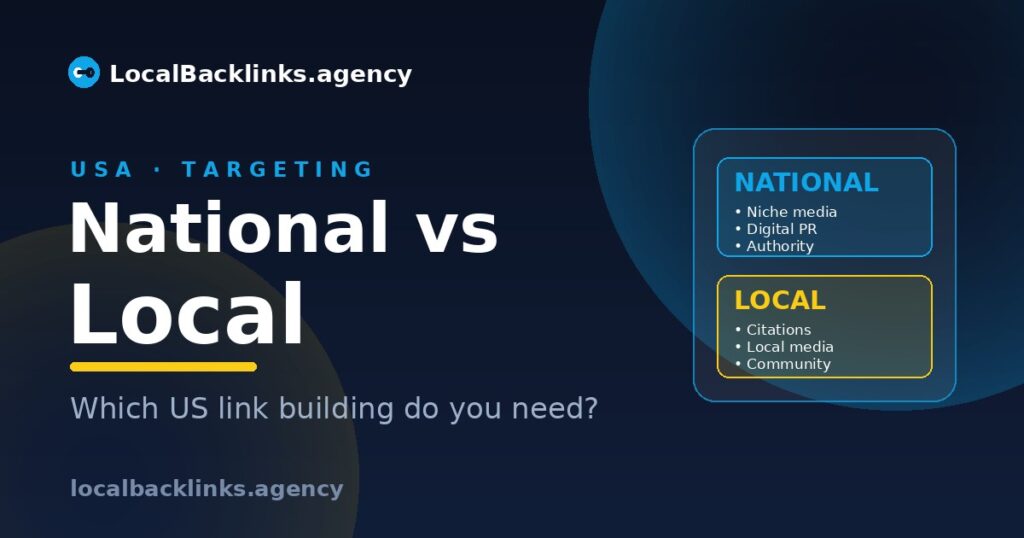
“Build US backlinks” means two completely different things depending on whether you’re competing for national keywords or local ones. The link sources, the anchors, even the definition of a “good” link change with it — and using the wrong approach is one of the most common reasons US campaigns underperform. This article explains how national and local US link building differ, how to tell which you need, and what to do if you need both. For the bigger picture, see our complete guide to US backlinks.
Why “the US” is really many markets
The United States isn’t a single search market — it’s a national market sitting on top of fifty state markets and hundreds of metro markets. A query like “project management software” is fought nationally against brands and big budgets. A query like “emergency plumber Denver” is fought locally, in the map pack and local results, against nearby businesses. The links that win one do little for the other. So before you build anything, the first decision is: which game are you playing?
How to tell which you need
Ask what your customers actually search and where you serve them:
- You need national link building if you sell nationwide — SaaS, e-commerce, information/affiliate sites, national service brands — and you’re chasing broad keywords without a geographic modifier.
- You need local link building if you serve specific places — a clinic, law firm, restaurant, contractor, or a multi-location chain — and your customers search with city or “near me” intent.
- You need both if you’re a multi-location business or a brand that competes nationally and wants to win specific metros.
The simplest tell: do your money keywords have a place name (or an implied “near me”) in them? If yes, local is central. If no, you’re playing the national game.
National US link building
National rankings are won on authority and topical relevance at scale, because your competitors have a lot of both. The priorities:
- Authoritative, broad-reach sources. National publications, respected niche media and high-authority blogs with US-wide audiences.
- Digital PR. Original data, studies and expert commentary that earn links from national outlets — the highest-trust national signal (see digital PR in the US).
- Topical relevance. Links from sites genuinely in your niche, which tell Google you belong among the national authorities in that space.
- Volume of quality. National head terms usually require more relevant referring domains than local terms — match the competitive benchmark (how many backlinks to rank in the US).
What doesn’t help much nationally: purely local citations and directory listings. They’re foundational for local SEO but won’t move a national head term.
Local US link building
Local rankings are won on geographic relevance and trust, and the link sources are different:
- Local citations. Consistent name, address and phone (NAP) listings in directories, plus Google Business Profile — the foundation of local SEO (see local citations for US local SEO).
- Local media and regional blogs. City newspapers, regional news sites and community blogs that signal you’re part of the local web.
- Local organisations. Chambers of commerce, local business associations, sponsorships, and community partnerships — genuine local relationships that earn links.
- Locally-relevant content. City guides, local resources and area-specific pages that attract local links naturally.
For local, a handful of genuinely local links can outrank a competitor with more national links, because they reinforce exactly the geographic signal local search rewards. Relevance to the place is the whole game.
A quick comparison
- Goal: National = broad keyword authority. Local = geographic relevance for city/”near me” terms.
- Best sources: National = niche publications, national media, digital PR. Local = citations, local media, community links.
- What matters most: National = authority + topical relevance. Local = NAP consistency + local relevance + reviews.
- Typical volume: National = higher (competition is fiercer). Local = fewer, but genuinely local.
Handling multi-location and “both”
If you’re a multi-location business or a brand that needs national authority and local visibility, structure it deliberately:
- Build national authority to your main domain with digital PR and niche links — this lifts the whole site.
- Create proper location pages for each city you serve, and point local links and citations at the relevant location page, not just the homepage.
- Keep NAP consistent across every location’s listings — inconsistency is a classic local-SEO killer.
- Don’t spread thin. It’s better to fully build a few priority locations than to half-build many.
The national authority you build makes your local pages more competitive, and the local signals make each location rank in its market — they compound when structured properly.
Common mistakes
- Using national tactics for local goals (or vice versa) — the most common and most wasteful error.
- Pointing all local links at the homepage instead of the relevant location page.
- Ignoring citations and NAP consistency when local matters.
- Expecting local citations to win national head terms — they won’t.
- Trying to rank every location at once instead of prioritising.
FAQ
Do local citations help national rankings?
Barely. Citations are foundational for local SEO but do little for national head terms, which are won on authority and topical relevance.
Can one campaign do both national and local?
Yes, if structured deliberately — build national authority to the main domain and point local links/citations at dedicated location pages. Prioritise rather than spreading thin.
How do I know if my keywords are local or national?
Check for a place name or implied “near me” intent. Geographic modifiers mean local; broad terms without them mean national.
Are local links easier to get than national ones?
Often, yes — local media, directories and community links are more accessible than national publications, and a few relevant ones go a long way for local rankings.
Bottom line
Decide which game you’re playing before you build. National link building is about authority and topical relevance at scale; local is about geographic relevance, citations and community links. Multi-location brands need both, structured around location pages and consistent NAP. Match the method to the goal and your US links actually move rankings instead of being wasted. Not sure which mix you need? Request a free US plan and we’ll map it to your markets, or see our USA backlink packages for national and local options.
Related reading: For the principles that apply in every market, see the complete guide to backlinks, and for the general version of this topic read local backlinks.


Leave a Reply