What Makes a High-Authority US Backlink?
“High-authority backlinks” is the most over-used phrase in US SEO — and one of the most misunderstood. Sellers wave a big Domain Rating number and call it authority. But in the most competitive market in the world, a high score on a tool is not the same as genuine authority, and confusing the two is how people waste budgets on links that do nothing. This article explains what real US backlink authority actually is, the tiers of it, and how to tell the genuine article from an inflated number. For the wider strategy, see our complete guide to US backlinks.
Authority is not a single number
Domain Rating (Ahrefs), Domain Authority (Moz) and Trust Flow (Majestic) are useful estimates, but they’re third-party scores — and DR in particular can be inflated by manipulative links. A site can show DR 75 and have almost no genuine standing. Real authority is what those metrics are trying to approximate: whether a site is genuinely trusted, genuinely read, and genuinely relevant. In the US, where every competitor has access to the same tools and the same tricks, the number alone tells you very little. You have to look behind it.
The four components of genuine US authority
1. Real US organic traffic
The single hardest signal to fake. A genuinely authoritative US site ranks for real keywords and receives real visitors — and for US targeting, those visitors should be substantially American. A DR 70 site with a few hundred visits a month, or traffic from unrelated countries, has borrowed authority, not earned it. Always check the traffic and its geographic split, not just the score.
2. Topical authority in your niche
General authority matters less than authority in your space. A respected US SaaS publication linking to your SaaS product passes far more relevant authority than a high-DR general-news site that has never covered your topic. Google increasingly rewards topical relevance, so a site that’s a recognised voice in your niche is worth more to you than a bigger but unrelated one.
3. Trust and credibility signals
Genuine authority shows in the details: a real brand and business behind the site, named authors with credentials, editorial standards, and a sensible, relevant set of sites linking to it. Who an authoritative site associates with — and who associates with it — is part of what makes it trusted.
4. Editorial link context
Even an authoritative site passes little if your link is buried in a footer or an irrelevant aside. Authority flows best through a contextual, editorial link inside relevant content — the kind a real editor would place because it genuinely adds value for the reader.
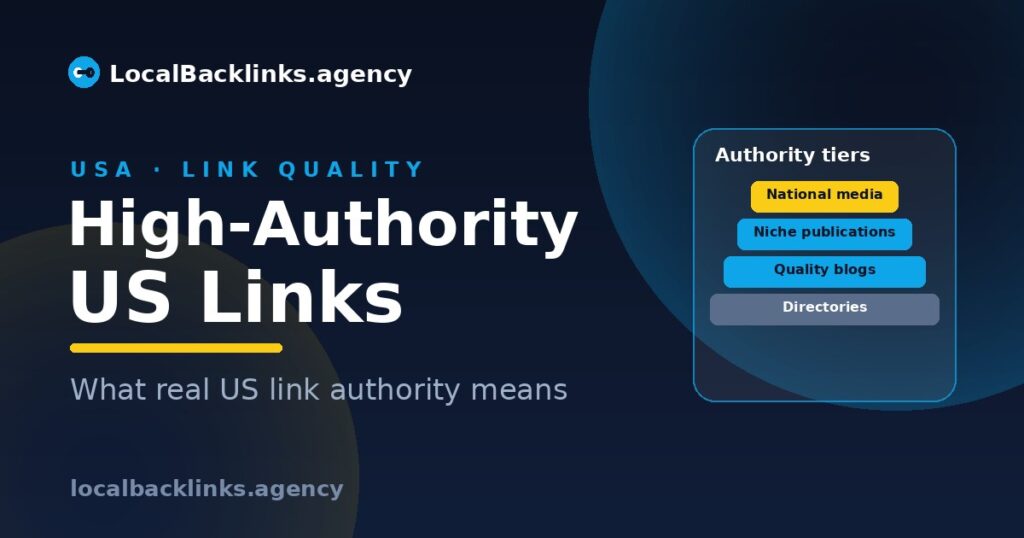
The US authority tiers
It helps to think of American link sources as a hierarchy. Higher tiers are harder to earn and more powerful:
- Tier 1 — National media and major publications. Recognised US news and industry outlets. The hardest to earn (usually via digital PR) and the most trusted.
- Tier 2 — Established niche publications. Respected sites that are genuine authorities in a specific vertical. Often the best value: highly relevant and genuinely authoritative.
- Tier 3 — Quality independent blogs and resource sites. Real sites with real audiences in your niche. The workhorse of most campaigns.
- Tier 4 — Directories, citations and listings. Foundational, especially for local SEO, but low individual authority.
A strong US profile is concentrated in Tiers 2–3 with the occasional Tier 1, supported by Tier 4 where relevant. Chasing only the biggest names is slow and unnecessary; ignoring relevance to grab any high-DR link is a mistake.
Why the domain extension has nothing to do with authority
It’s worth repeating because it confuses people: in the US, the .US extension carries no authority advantage. American authority lives on .COM (and plenty of .org, .gov and .edu), so a site’s standing comes from its traffic, relevance and trust — never its ending. Don’t pay a premium for “.US authority”; pay for genuine authority wherever it sits.
How to actually measure US authority
Triangulate — never trust one metric:
- Cross-check DR/DA with real organic traffic (Ahrefs/Semrush) and confirm it’s US traffic.
- Compare DR with Trust Flow. A healthy site has them roughly in proportion; a big gap (high DR, low Trust Flow) suggests inflated authority.
- Read the site. Is it a real publication with editorial standards, or a thin shell that publishes anything for a fee?
- Check relevance. Does it actually cover your topic, and would your link make sense to a reader?
If a site passes all four, it has genuine authority. If it only passes the DR check, it has a number.
Signs of fake authority
- High DR with negligible or non-US organic traffic
- DR far higher than Trust Flow
- “Write for us” sites publishing every niche under the sun
- No named authors, no editorial standards, no real brand
- Pages stuffed with outbound links to unrelated commercial sites
- Authority that spiked suddenly rather than grew over time
A worked example
Site A: a US fintech publication, DR 58, Trust Flow 22, ~40,000 monthly organic visits mostly from the US, named expert authors, covers your exact niche. Your link sits in a relevant editorial article. Genuine Tier-2 authority — exactly what you want.
Site B: DR 78, Trust Flow 5, ~600 monthly visits from scattered countries, publishes finance, casinos, supplements and travel side by side, no named authors, dozens of outbound commercial links per page. A high number with no real authority — skip it.
The lower DR is the stronger link. In the US, that’s almost always how it goes.
FAQ
Is a high Domain Rating enough for a US backlink?
No. DR is easily inflated. Genuine US authority requires real US traffic, topical relevance and trust signals alongside the score.
What’s more important — authority or relevance?
Relevance usually wins. A relevant Tier-2 niche site often outperforms a bigger but unrelated high-DR site for your rankings.
Do .gov and .edu links carry special authority?
They can be trusted sources, but they’re not automatic wins — relevance and context still decide their value, like any link.
How do I check if a site’s authority is real?
Cross-check DR with real US organic traffic and Trust Flow, then read the site to confirm it’s a genuine, relevant publication rather than a link shell.
Bottom line
High authority in the US isn’t a number on a tool — it’s real traffic, real relevance and real trust, concentrated in genuine niche publications and quality sites rather than inflated domains. Judge every prospect on substance, aim for Tiers 2–3, and never pay for a score that isn’t backed by an audience. Want only genuinely authoritative, relevant US sites in your campaign? That’s what our USA backlink packages are built to deliver — or request a free US plan and we’ll show you the kind of sites we’d target for your niche.

Leave a Reply