PageRank Explained: How Google’s Link Algorithm Works
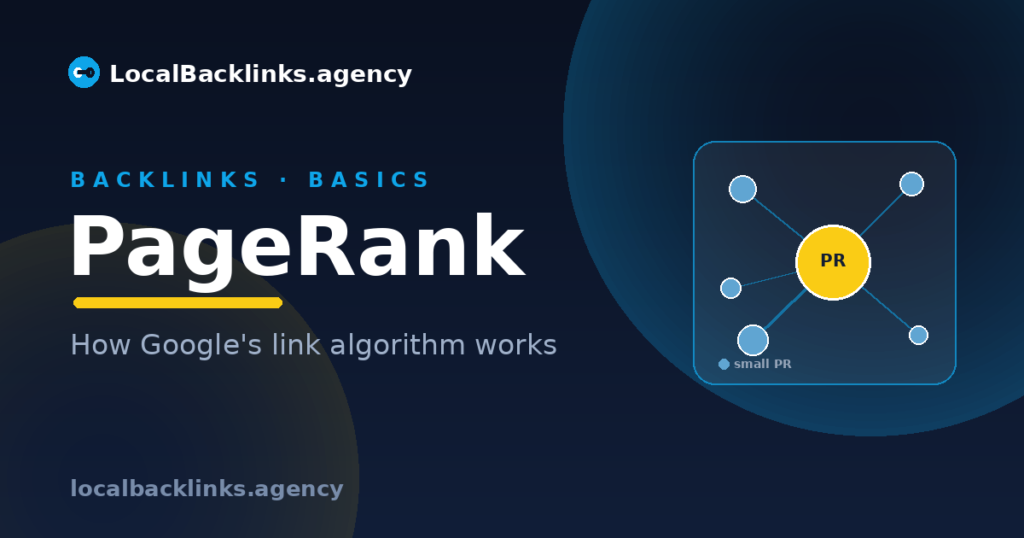
PageRank is the algorithm that made Google, Google — and even though it has evolved enormously, the idea behind it still shapes how links work in SEO today. If you understand PageRank, you understand why some backlinks are worth far more than others. This guide explains it in plain language: what PageRank is, how it works, and why it still matters. For the basics first, see what backlinks are; for the bigger picture, see how Google uses backlinks and our complete guide to backlinks.
What is PageRank?
PageRank is an algorithm developed by Google’s founders, Larry Page and Sergey Brin, at Stanford in the late 1990s. (The name is a pun — it ranks pages, and it’s named after Larry Page.) Its job was to measure the importance of a web page based on the links pointing to it. This was a breakthrough: instead of ranking pages purely on the words they contained — which was easy to manipulate by stuffing keywords — Google could rank them on what the rest of the web “said” about them through links.
That single idea let Google return far better results than its rivals, and link-based authority has been central to search ever since.
Links as votes — with a twist
The core concept is that each link to a page counts as a vote of confidence. A page with many links pointing to it looks more important than one with few. So far, so simple — but PageRank added a crucial twist: not all votes are equal.
A vote from an important page (one that itself has many links) counts for much more than a vote from an obscure one. And importance flows: a page made important by its own links passes more value along when it links out. This recursive idea — your importance depends on the importance of the pages linking to you, whose importance depends on the pages linking to them — is what made PageRank powerful. It’s also why, to this day, one link from a strong, authoritative site can outweigh dozens from weak ones.
How PageRank flows (link equity)
Think of PageRank as a quantity that flows through links. When a page links out, it passes a share of its PageRank to the pages it links to. Two practical consequences follow:
- The strength of the linking page matters. A link from a high-PageRank page passes more value.
- The number of links on that page matters. If a page links to many places, its PageRank is split among them, so each link passes a smaller share. A link from a page with few outbound links can be worth more than one from a page stuffed with hundreds.
This flow of value is what SEOs call link equity, or informally “link juice” — and it applies to your internal links too, distributing authority around your own site. We cover it in depth in link equity.
The “random surfer” idea
PageRank was often described using a “random surfer” model: imagine someone clicking links at random across the web forever. The pages they’d land on most often are the most important — because more paths of links lead to them. A “damping factor” accounted for the surfer occasionally stopping and jumping to a random page instead of always clicking onward. You don’t need the maths to use the insight: pages that many link paths lead to are treated as more important, which is exactly why earning links from well-connected, relevant pages helps so much.
The toolbar PageRank score (and why it’s gone)
For years, Google showed a public PageRank score (0–10) in its toolbar, and SEOs obsessed over it. Google stopped updating it publicly and retired it years ago, because it was crude, easily gamed, and encouraged link buying based on a single number. Public PageRank no longer exists — so if anyone sells links based on a site’s “PageRank,” that’s a red flag. Today, third-party metrics like Ahrefs’ Domain Rating and Moz’s Domain Authority are used as rough proxies for link authority, but they’re estimates, not Google’s actual PageRank.
Does PageRank still matter today?
Yes — but in evolved form. Google has confirmed it still uses PageRank internally as one of many signals; what’s changed is everything around it. Modern Google layers on relevance, content quality, user signals, trust, and sophisticated spam detection that devalues manipulative links rather than letting them pass PageRank. So raw PageRank is no longer something you can chase with bulk links — but the underlying principle, that authority passes through quality links, remains very much alive. Our guide to link authority covers how this is judged now.
What PageRank means for your link building
The lessons PageRank teaches map directly onto good link building:
- Quality beats quantity — a link from a strong, relevant page is worth many weak ones.
- Authority flows — earning links from well-linked, relevant pages passes more value.
- Outbound link count matters — a link from a page that links out sparingly can be worth more.
- Internal links count — they distribute authority around your own site, so link to your important pages.
None of this requires understanding the algorithm’s maths — just its principle. Put it into practice with our overview of how to get backlinks, or let our link building services handle it.
FAQ
What is PageRank in simple terms?
It’s Google’s original algorithm for measuring a page’s importance based on the links pointing to it, treating links as votes where votes from important pages count more.
Does Google still use PageRank?
Yes, internally, as one of many ranking signals — but the public toolbar score was retired years ago and no longer exists.
Is PageRank the same as Domain Authority or Domain Rating?
No. DA and DR are third-party estimates of link authority used as rough proxies. They are not Google’s actual PageRank, which isn’t public.
How do I increase my PageRank?
You can’t target a public score anymore, but you build the underlying authority the same way: earn quality, relevant links from authoritative pages and link sensibly within your own site.
In summary
PageRank is the link-based algorithm that launched Google, built on a simple but powerful idea: links are votes, votes from important pages count more, and authority flows through the link graph. The public score is gone and modern Google adds many other signals, but the principle still drives link building — quality, authoritative, relevant links pass real value. Want the full picture? Read our complete guide to backlinks, or get a free plan for earning the kind of links that carry authority.

Leave a Reply