How Many German Backlinks Do You Actually Need?
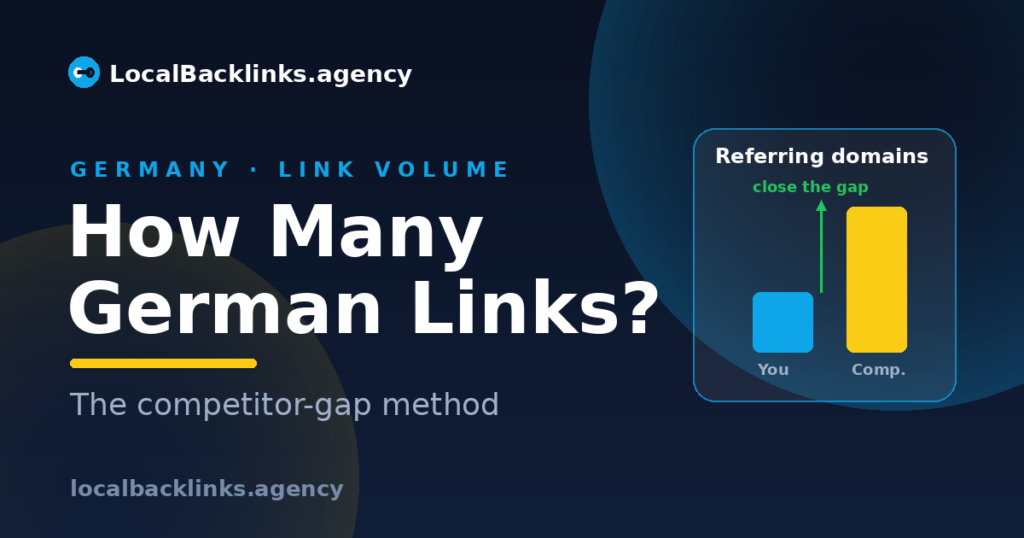
“How many German backlinks do I need to rank?” is the question every client asks, and the honest answer is: there’s no fixed number. The right amount depends on your niche, your current authority and — most of all — what the sites already ranking for your German keywords have. This guide shows you how to work out a realistic target using the competitor-gap method, and why quality and pace matter more than any headline figure. For the full strategy, see our complete guide to German backlinks.
Why there’s no magic number
Anyone who promises “50 links and you’ll rank #1 in Germany” is guessing. Rankings depend on dozens of factors — your on-page SEO, site authority, content quality, user signals and the competitiveness of the keyword — and links are only one of them. The number of links needed to rank for a low-competition German term might be a handful; for a commercial head term it could be many times that. So instead of chasing a number, you reverse-engineer it from the competition.
The competitor-gap method (step by step)
This is the practical way to set a realistic German link target:
- Pick your target keyword and search it on Google.de (set your location/region to Germany, or use a tool with German results).
- List the top 5–10 ranking pages for that term.
- Check each page’s referring domains in Ahrefs, Semrush or Moz — focus on referring domains (unique linking sites), not total backlinks, which can be inflated.
- Note the quality and relevance of those links, not just the count — how many are genuinely German, relevant and high-traffic?
- Compare to your own page. The gap between your relevant referring domains and theirs is your real target.
If the pages ranking for your German keyword have, say, 20–40 relevant referring domains and you have 5, you now have a grounded goal: close that gap with better, more relevant links — not simply more of them.
Quality changes the math
The competitor-gap number assumes similar link quality. In practice, you can often rank with fewer links than competitors if yours are more relevant and authoritative. Ten genuinely relevant, German, real-traffic links can outperform fifty weak ones. So the count from the gap analysis is a ceiling, not a quota — strong, relevant .DE links let you hit the target with fewer placements (see what makes a good .DE backlink).
Velocity: how fast should you build?
Just as important as how many is how fast. A sudden flood of links to a young or low-authority site looks unnatural; steady, consistent growth looks like a site earning attention over time. As a general rule:
- Newer sites: start slow and build gradually — a steady trickle beats a spike.
- Established sites: can absorb more links per month, but consistency still matters.
- Avoid bursts of identical links in a short window — that’s a classic manipulation pattern.
Think months, not days. Link building is a compounding investment; the pages that hold rankings are the ones that built authority steadily.
A rough starting framework
Use this only as a rule of thumb, then refine with real competitor data:
- Low-competition German keywords: a small, relevant foundation can be enough — focus on relevance.
- Medium-competition: a steady programme over several months, matching competitor referring-domain counts.
- High-competition commercial terms: an ongoing campaign — these are won over quarters, not weeks, with both links and strong content.
The competitor-gap analysis turns these vague bands into a concrete target for your keyword.
Common mistakes when deciding “how many”
- Chasing a round number instead of the competitive reality of your keyword.
- Counting total backlinks rather than unique, relevant referring domains.
- Buying in bulk, fast to “catch up” — velocity spikes do more harm than good.
- Ignoring quality — more weak links won’t beat fewer strong ones.
- Treating links as the only lever — if your on-page SEO or content is weak, links won’t fix it.
How to track progress
Once you’ve set a target, measure the right things: your referring domains over time, your rankings in Google.de for the target keywords, and your German organic traffic in Search Console. If rankings move as your relevant referring domains approach the competitor benchmark, you’re on the right track. If they don’t, the bottleneck is probably elsewhere — content, relevance or site health — not link count.
FAQ
How many German backlinks do I need to rank on page one?
There’s no universal number — it depends on the keyword’s competition. Analyse the referring domains of the pages currently ranking and aim to match them with relevant, quality links.
Is it better to have more links or better links?
Better links. A smaller set of relevant, high-traffic German links typically outperforms a larger set of weak ones.
How fast can I build German backlinks safely?
Build steadily rather than in bursts. Newer sites should start slow; consistency over months is safer and more effective than a sudden spike.
Do I count total backlinks or referring domains?
Referring domains — the number of unique sites linking to you. Total backlink counts are easily inflated and less meaningful.
Bottom line
Forget magic numbers. Find the pages ranking for your German keyword, measure their relevant referring domains, and close the gap with steadily-built, high-quality .DE and German-language links. Quality lets you do it with fewer placements; sensible velocity keeps it safe. Want a target set for your keywords and the links built to match? See our Germany backlink packages or request a free Germany plan with a competitor-gap analysis included.
Related reading: For the principles that apply in every market, see the complete guide to backlinks, and for the general version of this topic read how many backlinks you need. For a rough starting range, use the required backlinks estimator.


Leave a Reply