German Anchor Text: A Practical Guide (with Ratios)
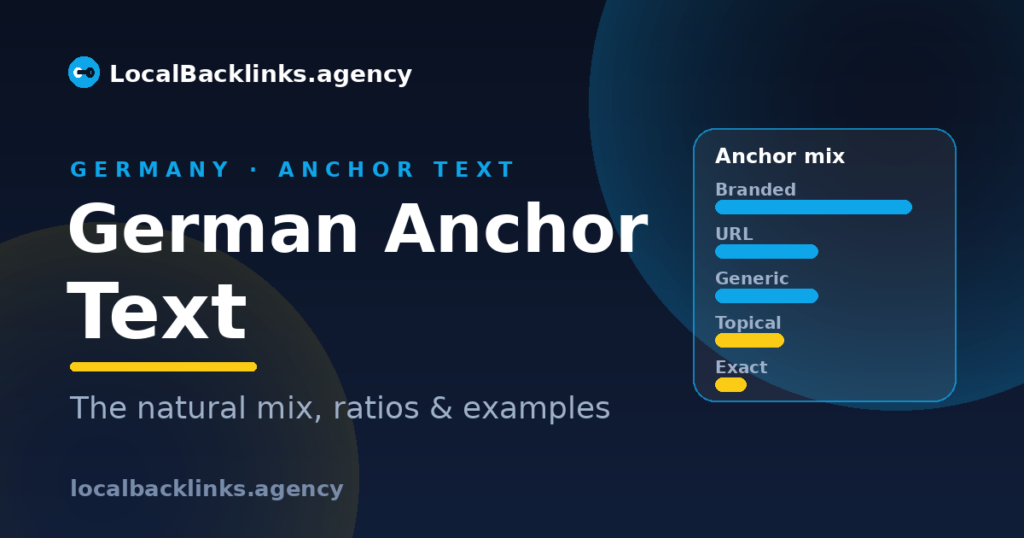
Anchor text — the clickable words a link is wrapped in — is one of the easiest parts of German link building to get wrong. Over-use your keyword and you send a textbook manipulation signal; ignore it and you leave relevance on the table. This guide covers what a natural German anchor profile looks like, how to handle German-language anchors specifically, the ratios to aim for, and the red flags that get profiles flagged. For the wider picture, see our complete guide to German backlinks.
Why anchor text matters (and why it’s risky)
Anchor text helps Google understand what the page you’re linking to is about. That’s useful — but it’s also one of the most abused ranking signals, so Google watches it closely. A profile where the same exact-match keyword appears in most anchors looks engineered, because real, editorially-earned links almost never behave that way. Real links mostly use your brand name, your URL, or natural phrases. The goal in German campaigns is to look like the second kind.
The anchor types you’ll use
- Branded — your brand or domain name (e.g. LocalBacklinks, localbacklinks.agency). The most common type in natural profiles.
- Naked URL — your raw address (e.g. https://example.de).
- Generic — non-keyword phrases. In German: hier, mehr erfahren, zur Website, weiterlesen, Quelle.
- Branded + keyword — your brand plus a topic word (e.g. LocalBacklinks Linkaufbau).
- Partial-match / topical — a natural phrase that includes part of your keyword (e.g. Tipps zum Linkaufbau in Deutschland).
- Exact-match — your precise target keyword (e.g. Backlinks kaufen). The most powerful and the most dangerous — use sparingly.
A natural German anchor ratio
There’s no official formula, and ratios should look organic rather than perfectly engineered, but a healthy, safe-leaning German profile tends to look roughly like this:
- Branded: ~40–50% — the backbone of a natural profile.
- Naked URL: ~15–20%
- Generic: ~15–20% — German generic phrases on German content.
- Partial-match / topical: ~10–15%
- Exact-match: ~5% or less — the smallest slice.
The exact percentages matter less than the shape: branded and generic anchors should dominate, and exact-match should be rare. If keyword anchors are your largest category, your profile is over-optimised.
German-language anchors: getting them right
On German-language pages, keyword-relevant anchors should be in German — an English exact-match anchor dropped into a German article looks unnatural to readers and to Google. Some practical examples by type:
- Generic (German): hier, mehr dazu, mehr erfahren, zur Anbieter-Website, weiterlesen.
- Topical / partial (German): professioneller Linkaufbau, hochwertige deutsche Backlinks, SEO für den deutschen Markt.
- Exact-match (German, sparingly): Backlinks kaufen, deutsche Backlinks, Linkaufbau Deutschland.
Branded anchors and naked URLs work in any language, so they’re easy wins for keeping the profile natural without forcing German keywords.
Over-optimisation red flags
- Exact-match dominates. If your top keyword is your most common anchor, that’s the clearest warning sign.
- The same anchor, repeated. Identical exact-match anchors across many links look automated. Vary the wording.
- Anchors that don’t match the page. Keyword anchors pointing at irrelevant pages read as manipulation.
- No brand or generic anchors at all. A profile with zero branded anchors doesn’t look like real editorial coverage.
- English keyword anchors on German pages. A mismatch that looks placed, not earned.
How to plan anchors for a German campaign
Work at the level of the whole profile, not the individual link. A simple approach:
- List your target pages and the German keyword(s) each should rank for.
- Set a profile-wide ratio (branded-led, as above) rather than deciding link by link.
- Front-load brand and generic anchors early in a campaign, especially for a newer page — it looks like natural discovery.
- Sprinkle partial-match phrases that read naturally inside German sentences.
- Add exact-match last and rarely, only once a healthy base exists.
- Vary every keyword anchor — never reuse the exact same phrase repeatedly.
A worked example (20 links)
For a German page targeting “Backlinks kaufen”, a natural 20-link plan might be:
- 9 branded — brand name / domain variations
- 3 naked URLs
- 4 generic — hier, mehr erfahren, zur Website, weiterlesen
- 3 partial/topical — hochwertige Backlinks, Linkaufbau für deutsche Seiten, deutsche SEO-Links
- 1 exact-match — Backlinks kaufen
Notice the single exact-match anchor among twenty. That restraint is exactly what keeps the profile looking earned rather than engineered.
Anchor text is part of a bigger picture
Even a perfect anchor mix won’t save links from weak, irrelevant sites — relevance and site quality come first (see what makes a good .DE backlink). Likewise, anchors should sit inside genuine German-language content (covered in do you need German-language content). Anchor text is one lever; pull it gently.
FAQ
What percentage of anchors should be exact-match for German links?
Keep it small — roughly 5% or less. Branded and generic anchors should make up the bulk of a natural profile.
Should German backlinks use German anchor text?
On German-language pages, keyword-relevant anchors should generally be German. Branded anchors and URLs work in any language.
Is it bad to reuse the same anchor across links?
Repeating the same exact-match anchor across many links looks automated. Vary the wording, even for the same target keyword.
Do branded anchors help SEO if they’re not keywords?
Yes — they build a natural profile and brand signals, and they make your occasional keyword anchors look earned rather than manipulative.
Bottom line
A safe German anchor profile is branded-led, uses German generic and topical phrases, varies its wording, and keeps exact-match keywords to a small slice. Plan at the profile level, build the brand and generic base first, and add keyword anchors sparingly. If you’d rather have anchor strategy handled as part of your campaign, our Germany backlink packages include natural anchor planning — or get a free Germany plan tailored to your target keywords.

The point about balancing relevance with a natural anchor profile is especially important for German SEO, where exact-match keywords can quickly become overused. One thing I’ve noticed is that mixing branded, partial-match, and generic anchors often makes link patterns look more authentic while still reinforcing topical signals. The suggested focus on ratios rather than individual links is a practical way to think about it.