What Is a Backlink Profile? (And a Healthy One)
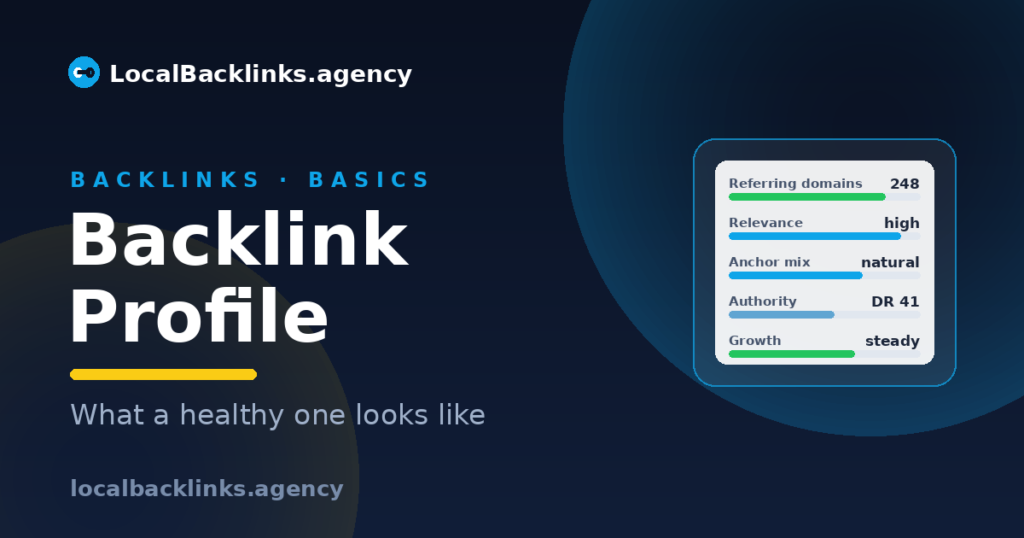
People talk about having a “strong” or “natural” backlink profile, but what does that actually mean? Your backlink profile is the full picture of every link pointing to your site — and learning to read it is how you judge your own SEO health and spot problems early. This guide explains what a backlink profile is, what a healthy one looks like, and what to watch. For the wider picture, see our complete guide to backlinks.
What is a backlink profile?
Your backlink profile is the complete collection of all the backlinks pointing to your website, plus their characteristics taken as a whole. It’s not a single number — it’s the overall shape of your links: where they come from, how relevant they are, what anchor text they use, whether they’re dofollow or nofollow, how authoritative the sources are, and how the profile has grown over time. When Google assesses your site’s authority and trust, it’s effectively reading this whole picture, not individual links in isolation.
What makes up a backlink profile
Several dimensions together describe your profile:
- Referring domains — how many unique sites link to you (more meaningful than total link count). See referring domains vs backlinks.
- Relevance — how topically related your linking sites are.
- Authority and trust — the strength and cleanliness of the linking sites (see link authority and link trust).
- Anchor text distribution — the mix of branded, generic, topical and exact-match anchors (see anchor text).
- Link attributes — the spread of dofollow, nofollow, sponsored and ugc links.
- Link velocity — the pace at which links have been gained over time.
- Link types — the variety of sources (editorial, guest posts, directories, and so on).
What a healthy backlink profile looks like
A healthy, natural profile tends to share these traits:
- Mostly relevant links from sites related to your niche.
- A range of authority — some strong sites, plenty of ordinary ones (real profiles aren’t all high-DR).
- A natural anchor mix — branded- and generic-led, with exact-match a small slice.
- A mix of link attributes — dofollow plus nofollow, sponsored and ugc.
- Diverse sources and types — not all from one kind of site or one method.
- Steady growth — links gained consistently over time, without sudden spikes.
In short, a healthy profile looks like the links a real, growing business would naturally attract.
What an unnatural profile looks like
By contrast, the warning signs of a manipulated profile include: a high proportion of irrelevant links; exact-match keyword anchors dominating; links concentrated from one type of low-quality source; sudden spikes in link velocity; and many links from trafficless or spammy sites. These are exactly the patterns Google’s spam systems are tuned to catch — and a profile like this can see its links devalued or, in serious cases, trigger a penalty. We cover prevention and recovery in white-hat vs black-hat link building.
How to check and monitor your profile
Use Google Search Console (free) to see your own links, and tools like Ahrefs, Semrush or Moz for fuller analysis — referring domains over time, anchor distribution, authority, and any toxic links. Reviewing your profile periodically lets you catch problems early, spot opportunities, and benchmark against competitors. When you do find genuinely harmful links, our guide to toxic backlinks and disavow explains the careful way to handle them.
How to build a strong profile
The way to a strong profile isn’t tricks — it’s consistency: earn relevant, quality links from a variety of real sources, keep your anchors natural, build at a steady pace, and let the profile grow the way a genuine business’s would. Our overview of how to get backlinks covers the methods, or our link building services build profiles this way for you.
FAQ
What is a backlink profile?
It’s the complete set of links pointing to your site, plus their overall characteristics — relevance, authority, anchors, attributes and growth — taken together.
What does a healthy backlink profile look like?
Mostly relevant links, a natural range of authority, a natural anchor mix, varied attributes and sources, and steady growth over time.
How do I check my backlink profile?
Use Google Search Console for your own links and tools like Ahrefs or Semrush for deeper analysis of referring domains, anchors and authority.
Can a bad backlink profile hurt me?
Yes — an unnatural profile (irrelevant links, over-optimized anchors, spikes, spammy sources) can see links devalued or, in serious cases, trigger a penalty.
In summary
Your backlink profile is the whole picture of your links — relevance, authority, anchors, attributes and growth — and a healthy one looks like what a real business would naturally earn: relevant, varied, naturally-anchored and steadily grown. Monitor it, keep it natural, and build consistently. Read our complete guide to backlinks or get a free plan.

Leave a Reply