rel=Sponsored & rel=UGC Link Attributes Explained
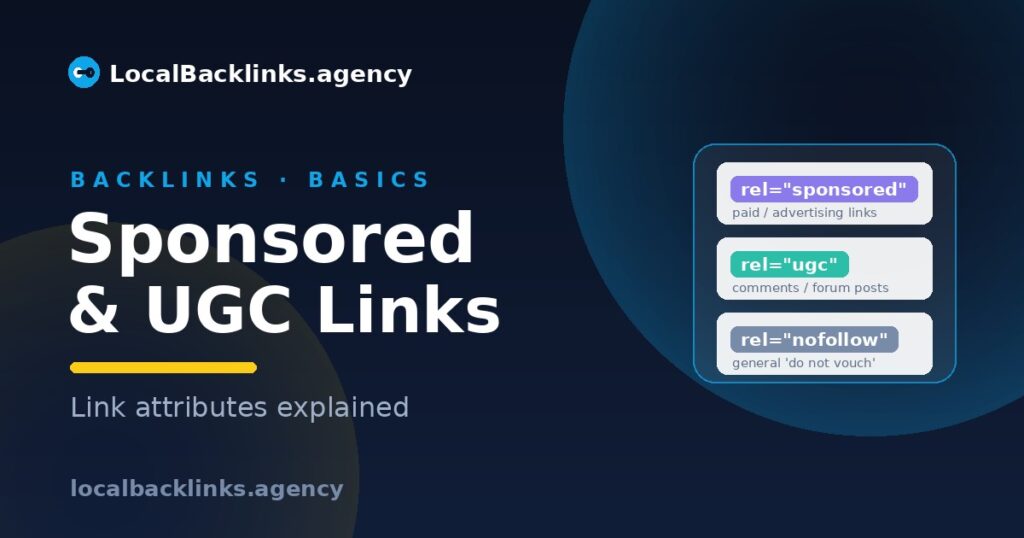
Beyond dofollow and nofollow, Google supports two more specific link attributes: rel=”sponsored” and rel=”ugc”. They’re newer, less talked about, and often confused — but understanding them helps you read link profiles correctly and stay on the right side of Google’s guidelines. This guide explains both clearly. For the basics first, see dofollow vs nofollow; for the full picture, see our complete guide to backlinks.
Why these attributes exist
For years, the only options were a normal (dofollow) link or a rel="nofollow" link. That single nofollow tag had to cover everything from spammy comments to paid placements, which gave Google little detail about why a link shouldn’t be fully trusted. In 2019, Google introduced two more granular attributes — sponsored and ugc — so sites could describe links more precisely. Google now treats all three (nofollow, sponsored, ugc) as hints it can consider, rather than strict commands.
What is rel=”sponsored”?
The rel="sponsored" attribute marks links that were created as part of advertising, sponsorships, or other paid arrangements. If a link exists because money or another form of compensation changed hands, sponsored is the correct attribute. This matters because Google’s guidelines require that paid links not pass ranking credit — labelling them sponsored is the transparent way to comply. In many countries, disclosing paid or sponsored content is also a legal expectation, so the attribute aligns with advertising rules as well as SEO ones.
What is rel=”ugc”?
The rel="ugc" attribute marks links in user-generated content — places where visitors, not the site owner, create the content. The classic examples are blog comments and forum posts. Because the site owner didn’t place these links and can’t vouch for them, the ugc attribute tells Google they come from user contributions. Many platforms apply ugc (or nofollow) automatically to comment and forum links.
How they differ from nofollow
All three attributes signal that a link shouldn’t necessarily pass full ranking credit, but they describe different reasons:
- nofollow — a general “don’t fully vouch for this” signal.
- sponsored — specifically a paid or advertising link.
- ugc — specifically a user-generated link (comments, forums).
A link can even carry more than one attribute where it applies. The practical effect on ranking value is broadly similar — these links generally don’t pass full credit — but the labels give Google clearer context.
Why this matters for your link building
Two takeaways. First, paid placements should be labelled honestly. If you buy a link, the compliant, transparent approach is a sponsored attribute and (where required) a disclosure. A profile of paid links all marked as plain dofollow is exactly the footprint Google’s spam systems look for — so honest labelling is safer, not weaker. Second, a natural profile contains a mix. Real sites accumulate dofollow, nofollow, sponsored and ugc links over time, so a varied attribute mix looks genuine, while an all-dofollow profile looks engineered. We cover the risk side in white-hat vs black-hat link building.
Do sponsored and ugc links have any value?
Yes — like nofollow links, they still drive referral traffic and brand exposure even when they don’t pass full ranking credit, and they contribute to a natural-looking profile. A relevant link on a busy site is worth having regardless of its attribute. Judge the site’s quality and relevance first; the attribute is secondary. We expand on this in high-quality backlinks.
FAQ
What does rel=”sponsored” mean?
It marks a link created through advertising, sponsorship or a paid arrangement, signalling that it shouldn’t pass ranking credit.
What does rel=”ugc” mean?
It marks links in user-generated content like comments and forum posts, which the site owner didn’t place.
Are sponsored and ugc links the same as nofollow?
They work similarly — generally not passing full credit — but describe different reasons (paid vs user-generated). Google treats all three as hints.
Should paid links use rel=”sponsored”?
Yes. Labelling paid links as sponsored is the transparent, compliant approach and helps avoid the paid-link footprint Google penalises.
In summary
The sponsored and ugc attributes let sites describe links more precisely — sponsored for paid links, ugc for user-generated ones — and Google treats them, like nofollow, as hints. For link builders, the lessons are simple: label paid links honestly, and aim for a natural mix of attributes rather than an all-dofollow profile. Read our complete guide to backlinks or get a free plan.


Leave a Reply