What Are Backlinks? A Simple Beginner’s Guide
If you’ve started learning about SEO, you’ve heard that “backlinks” matter — but what actually is a backlink? This guide answers that in plain language, with simple examples, and no jargon you don’t need. By the end you’ll understand what backlinks are, how they work, why search engines care about them, and the main types you’ll come across. For the complete picture of link building, see our complete guide to backlinks; this article is the beginner-friendly starting point.
The simple definition
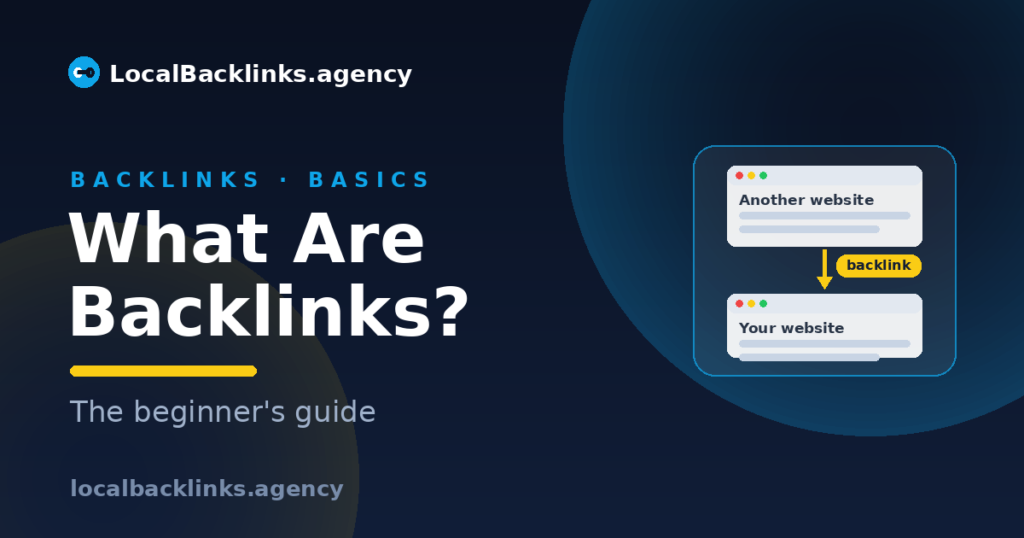
A backlink is a link from one website to another. When another website links to a page on your site, that link is a backlink for you. You’ll also hear them called inbound links or incoming links — they all mean the same thing: a link pointing to your site from somewhere else.
Here’s a simple example. Imagine a food blogger writes an article about kitchen gadgets and includes a link to your online store’s blender page. That link, sitting in their article and pointing to your store, is a backlink to your site. You now have one backlink from the food blog.
How backlinks actually work
To a search engine like Google, a backlink works a little like a recommendation or a vote of confidence. When one site links to another, it’s effectively saying, “this page is useful, relevant or trustworthy enough that I’m pointing my readers to it.” The more genuine recommendations a page collects from credible sources, the more important it looks.
A helpful comparison is academic research. When a research paper is cited by many other papers, scholars treat it as more influential and authoritative. Backlinks work similarly: a web page linked to by many relevant, trustworthy sites tends to be seen as more authoritative than a similar page with no links. This is the foundation of how the web’s “authority” is measured — and we explain the mechanics in how Google uses backlinks.
Why backlinks matter for SEO
Backlinks matter because they’re one of the strongest signals search engines use to decide what ranks. All else being equal, a page with more high-quality, relevant backlinks tends to rank higher in search results than a page without them. That’s why link building — the practice of earning and building backlinks — is such a core part of SEO.
But there’s an important catch that trips up beginners: not all backlinks are equal. A single link from a respected, relevant website can be worth more than hundreds of links from low-quality, unrelated ones. Quality and relevance matter far more than sheer numbers. We cover the full reasoning in why backlinks matter.
The parts of a backlink
It helps to know the two pieces that make up a link:
- The destination — the page the link points to (in our example, your blender page).
- The anchor text — the clickable words the link is wrapped in. If the blogger wrote “this powerful blender” and linked the words “powerful blender,” that phrase is the anchor text. Anchor text gives search engines a clue about what the linked page is about, which is why it matters — more in our anchor text guide.
Dofollow vs nofollow: a quick note
You’ll quickly run into the terms “dofollow” and “nofollow.” By default, links are dofollow, meaning they pass ranking signals to the destination. A nofollow link includes a small piece of code telling search engines not to pass full ranking credit — often used for paid, untrusted or user-generated links. Both types still send visitors and have value; a natural mix of both is healthy. The full explanation is in dofollow vs nofollow links.
Common types of backlinks
Backlinks come in many forms. A few you’ll encounter most:
- Editorial links — a writer genuinely chooses to link to you within their content. The most valuable kind.
- Guest post links — you write an article for another site and include a link back to yours.
- Directory and citation links — listings in business directories, important for local businesses.
- Profile and forum links — links from your profiles or forum posts on other sites.
- Resource links — when a site lists your page as a useful resource.
Each type has its own value and use, and a natural backlink profile contains a healthy mix rather than relying on any single one. You can explore them all in our main backlinks guide.
What makes a backlink “good”?
As a beginner, this is the most useful thing to remember: a good backlink is relevant, from a real and trusted site, and placed naturally in genuine content. A link from a site related to your topic, that real people actually visit, sitting inside a genuine article, is worth far more than a link from an unrelated, low-quality site. Chasing big numbers of weak links is the classic beginner mistake — and it can even backfire, because search engines may ignore or distrust spammy links.
How do you get backlinks?
There are many legitimate ways to earn and build backlinks: creating genuinely useful content that people want to link to, contributing guest articles to relevant sites, earning coverage from journalists (digital PR), getting listed in relevant directories, and building relationships with others in your industry. Each is a topic of its own — start with our overview of how to get backlinks when you’re ready to go further. If you’d rather have it handled professionally, that’s what our link building services are for.
FAQ
What is a backlink in simple terms?
A backlink is a link from another website to yours. It acts like a recommendation that tells search engines your page is useful or trustworthy.
Are backlinks good or bad?
Good, relevant backlinks help your SEO. Low-quality, spammy or irrelevant backlinks can do nothing or even harm you, so quality matters more than quantity.
How many backlinks do I need?
There’s no fixed number — it depends on your competition. A few relevant, high-quality backlinks can outperform hundreds of weak ones.
Do backlinks still matter in 2026?
Yes. Despite many predictions otherwise, backlinks remain one of the strongest ranking signals search engines use. What’s changed is the emphasis on quality and relevance over volume.
In summary
A backlink is simply a link from another website to yours, and search engines treat those links as votes of confidence that help decide what ranks. The key takeaway for any beginner: focus on quality and relevance, not raw numbers. A handful of genuine, relevant backlinks from real sites will do more for you than a pile of weak ones. Ready to go deeper? Read our complete guide to backlinks and link building, or get a free plan if you’d like help building them the right way.

Leave a Reply